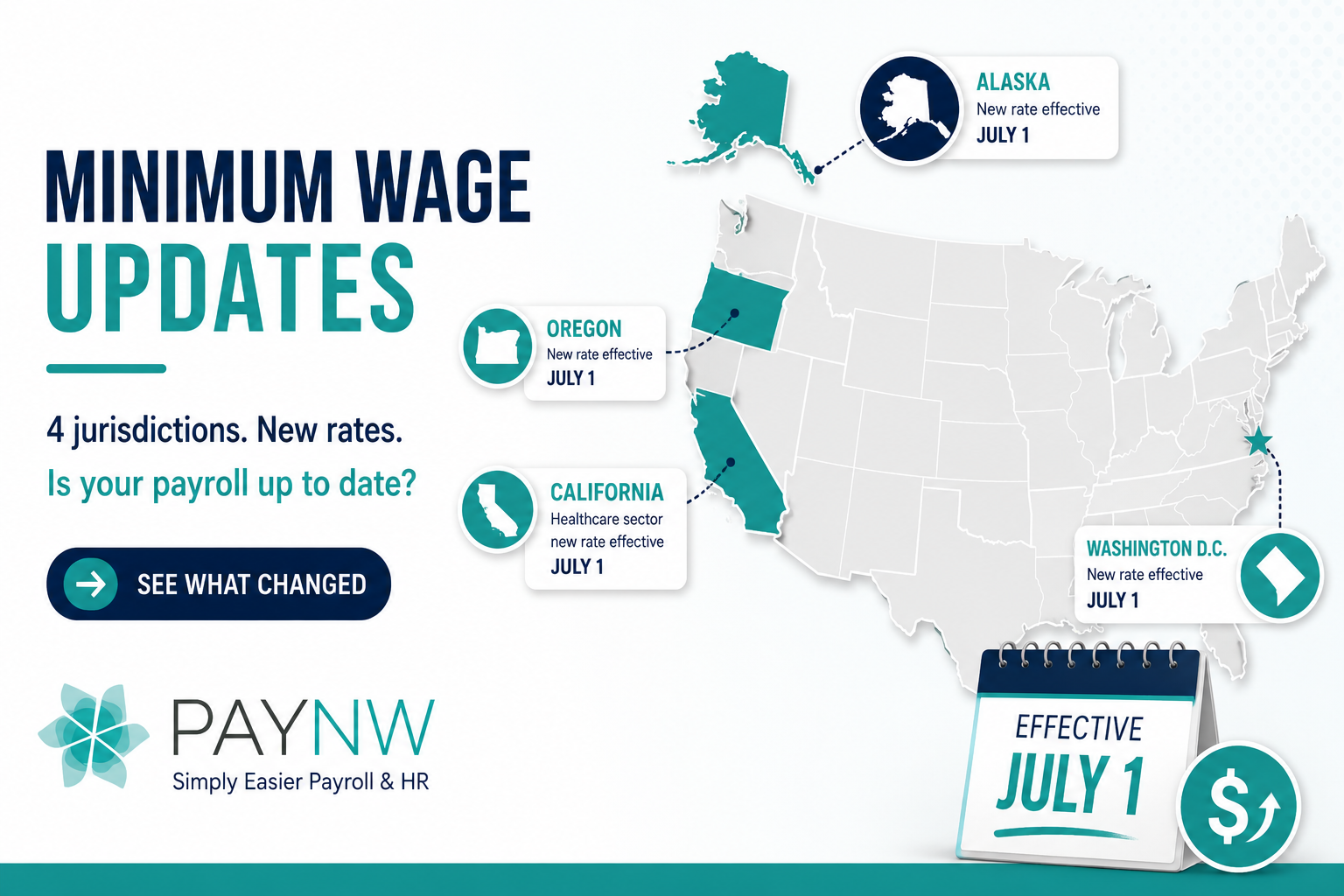
Most minimum wage increases take effect on January 1, but several jurisdictions follow a different schedule. On July 1, 2026, employers in Alaska, Oregon, Washington, D.C., and parts of California will see new wage floors take effect. If you have employees working in any of these locations, even remotely, now is the time to confirm your payroll rates are current.
Alaska: $14.00 per hour
Alaska's minimum wage rises from $13.00 to $14.00 per hour on July 1, 2026. The increase comes from Ballot Measure 1, approved by voters in November 2024, which set a fixed schedule of raises through 2027. The rate is scheduled to reach $15.00 per hour on July 1, 2027, after which Alaska will switch to annual inflation-based adjustments starting in 2028.
Alaska does not allow a tip credit, so tipped employees must receive the full $14.00 hourly rate before tips. The increase also affects exempt employees, since Alaska requires salaried workers who qualify for the executive, administrative, or professional exemption to earn at least twice the minimum wage for the first 40 hours worked. That pushes the minimum qualifying salary to $1,120 per week.
Oregon: three regional rates, all increasing
Oregon's minimum wage is unique in that it uses three separate rates depending on where the employee works, and all three update every July 1 based on inflation. Effective July 1, 2026, the rates are:
- Portland metro area: $16.80 per hour
- Standard counties: $15.55 per hour
- Non-urban counties: $14.55 per hour
The Portland metro rate applies to work performed inside the urban growth boundary, which includes parts of Clackamas, Multnomah, and Washington counties. The standard rate covers most other counties, including Benton, Lane, Marion, and Deschutes. The non-urban rate applies to a defined list of rural counties such as Coos, Klamath, and Umatilla.
Oregon does not allow a tip credit either, and the applicable rate is based on where the employee physically performs the work, not where the employer is headquartered. Employers with staff who split time across counties should track work location carefully, since the higher rate generally applies if an employee spends 50 percent or more of their hours in a single location.
Washington, D.C.: $18.40 per hour
The District of Columbia's minimum wage increases from $17.95 to $18.40 per hour on July 1, 2026, keeping it the highest minimum wage in the country. The increase is tied to the Consumer Price Index for the Washington metropolitan area and applies to all employers regardless of size.
D.C.'s tipped minimum wage also changes on the same date. Under a 2025 amendment to Initiative 82, the tipped wage moves to 56 percent of the standard minimum wage rather than continuing toward full elimination of the tip credit, bringing the tipped base rate to roughly $10.30 per hour. Employers must still make up the difference if tips do not bring an employee's total pay to at least $18.40 per hour.
California: healthcare worker rates under SB 525
California's general state minimum wage adjusts every January 1, but the state's healthcare-specific minimum wage under SB 525 follows its own schedule, with several categories increasing on July 1, 2026. Rates vary significantly by facility type:
- Large health systems, qualifying hospitals, and dialysis clinics move to $25.00 per hour
- Many other covered facilities, including skilled nursing facilities not affiliated with a hospital system, move to $23.00 per hour
- Community clinics, rural clinics, and certain physician groups move to $22.00 per hour
Because the rate depends on facility classification rather than a single statewide figure, healthcare employers should confirm which tier applies to each location before processing payroll. The increase also raises the minimum salary threshold for exempt nurse practitioners and physician assistants at covered facilities, since SB 525 ties exempt status to a percentage of the applicable healthcare minimum wage.
What employers should do before July 1
A handful of practical steps can prevent a wage and hour problem before it starts:
- Confirm the work location for every employee, including remote and hybrid staff, since minimum wage is generally tied to where work is performed.
- Update payroll systems to reflect the new rates by the effective date.
- Refresh required postings. Alaska, Oregon, and D.C. all publish updated minimum wage posters ahead of the July 1 effective date.
- Review pay above the new minimum for wage compression, particularly where a raise to the new floor brings entry-level pay close to what more tenured employees earn.
- Check exempt salary thresholds in jurisdictions where the minimum wage increase also moves the minimum salary required for exempt status, as is the case in Alaska and for California healthcare employers.
Sources
Oregon Bureau of Labor and Industries, Minimum Wage: https://www.oregon.gov/boli/workers/pages/minimum-wage.aspx
Alaska Department of Labor and Workforce Development, Minimum Wage Increase Notice: https://labor.alaska.gov/news/2026/news26-11.htm
D.C. Department of Employment Services, Office of Wage-Hour Compliance: https://does.dc.gov/service/office-wage-hour-compliance-0
California Department of Industrial Relations, Health Care Worker Minimum Wage FAQ: https://www.dir.ca.gov/dlse/Health-Care-Worker-Minimum-Wage-FAQ.htm