





Five Critical Questions to Determine Your HR and Payroll Compliance
Are you prepared for the next wave of tax, healthcare and regulatory changes affecting payroll and HR? Managing compliance can be complex and tricky...
5 min read

The clearest sign you've outgrown your payroll provider is simple: you've become their support team. You catch the errors before they hit a paycheck, you sit on hold when something breaks, and you re-explain your own account every time a new rep picks up. Most companies don't leave a provider over price or a missing feature. They leave because the service stopped showing up. Here are seven signs it's happening to you, and what a provider who actually answers looks like instead.
If getting help means a phone tree, a ticket number, and a two-day wait, that's a sign. Payroll problems are time-sensitive. A missed direct deposit or a wrong withholding can't sit in a queue while an employee waits to get paid correctly. When the only path to support is "open a ticket and hope," your provider has stopped treating your payroll as urgent.
The deeper problem is that you talk to someone different every time. You explain the whole situation again, and you might get a different answer than you got last week. Over time, you become the only person who actually remembers how your account is set up. That's a lot of weight to carry for a service you pay for. A provider who fits gives you a named contact who picks up, knows your account, and stays with you.
If you double-check every run because you don't trust the system to be right, the tool is working against you, not with you. Ernst & Young's 2022 payroll survey found the average company gets payroll right about 80 percent of the time, meaning roughly one in five payrolls carries an error, and each one costs about $291 to fix. When catching those falls to you, that's unpaid overtime nobody accounts for.
Those late nights add up. In the same EY research, the most common errors were the everyday ones: missed and incorrect time punches, the small stuff that slips through and lands on your desk to fix. A good provider builds review into the process and flags the likely problems before you run payroll, so accuracy isn't riding entirely on how carefully you proofread at 9 p.m.
When every conversation starts from zero because no one remembers your pay rules, your locations, or that one union agreement, you're holding knowledge the provider should hold. You end up managing the vendor instead of the vendor supporting you. The more specific your setup, the more this costs you.
It gets riskier when you're out. If you're the only person who understands how the account is configured, a vacation or a sick day becomes a problem for the whole company. A provider who knows your business is the one who catches the thing you forgot to mention. One who doesn't leaves you as the only safeguard.
If your real payroll process lives in a spreadsheet next to the software, the software isn't doing its job. Manual exports, re-keyed hours, and side calculations are all signs the system doesn't fit how you actually work. Every workaround is one more place an error can hide, and one more thing only you know how to run.
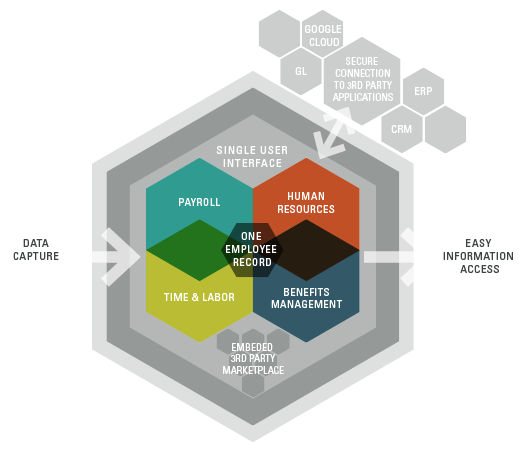
Disconnected tools are usually the root of it. When time tracking doesn't talk to payroll, or benefits deductions don't sync, someone has to bridge the gap by hand, and that someone is you. The point of a modern platform is that the pieces connect, so the same number doesn't get typed in three places. If you're the one holding it all together, you've outgrown the setup.
Tax rates and filing rules change all the time, and differently in every state. If you're not sure your provider is keeping up, or you've started tracking changes yourself just in case, that's a cost even when nothing goes wrong.
And the stakes are real. A missed rate update can mean penalties, plus the time it takes to sort out. A good provider updates the system before changes hit, checks its own work along the way, and tells you what changed and why. If yours goes quiet, you may be carrying more than your share of the responsibility.
The provider that fit at 25 employees may not fit at 150, or the moment you hired your first out-of-state worker. If adding a location, running payroll across state lines, or connecting a new system feels like forcing a square peg, you've outgrown the platform, not just the plan.
Multi-state is where this shows up fastest. Every new state brings its own registration, tax, and reporting rules, and a provider that makes that harder instead of easier turns growth into a headache. (Our guide on what employers need to know before hiring across state lines walks through what actually changes.) The right partner makes expansion feel routine, because they've done it many times before.
If your first instinct when something breaks is to avoid calling support, that tells you something real. It usually traces back to the very beginning. If you were handed logins and left to figure the system out yourself, the relationship started as self-service and never grew into a partnership. Service is a habit, and it forms on day one.
Onboarding is the tell because it's when a provider shows you what working together will feel like. A rushed, do-it-yourself launch tends to become rushed, do-it-yourself support. A provider who configures the system to your workflows, trains your team, and checks the first live runs with you is showing you the relationship you'll actually get. That difference is the whole reason people switch.
One rough week is normal. Three or more of these signs at once, and the pattern is the system, not the season. Here's the contrast, side by side.
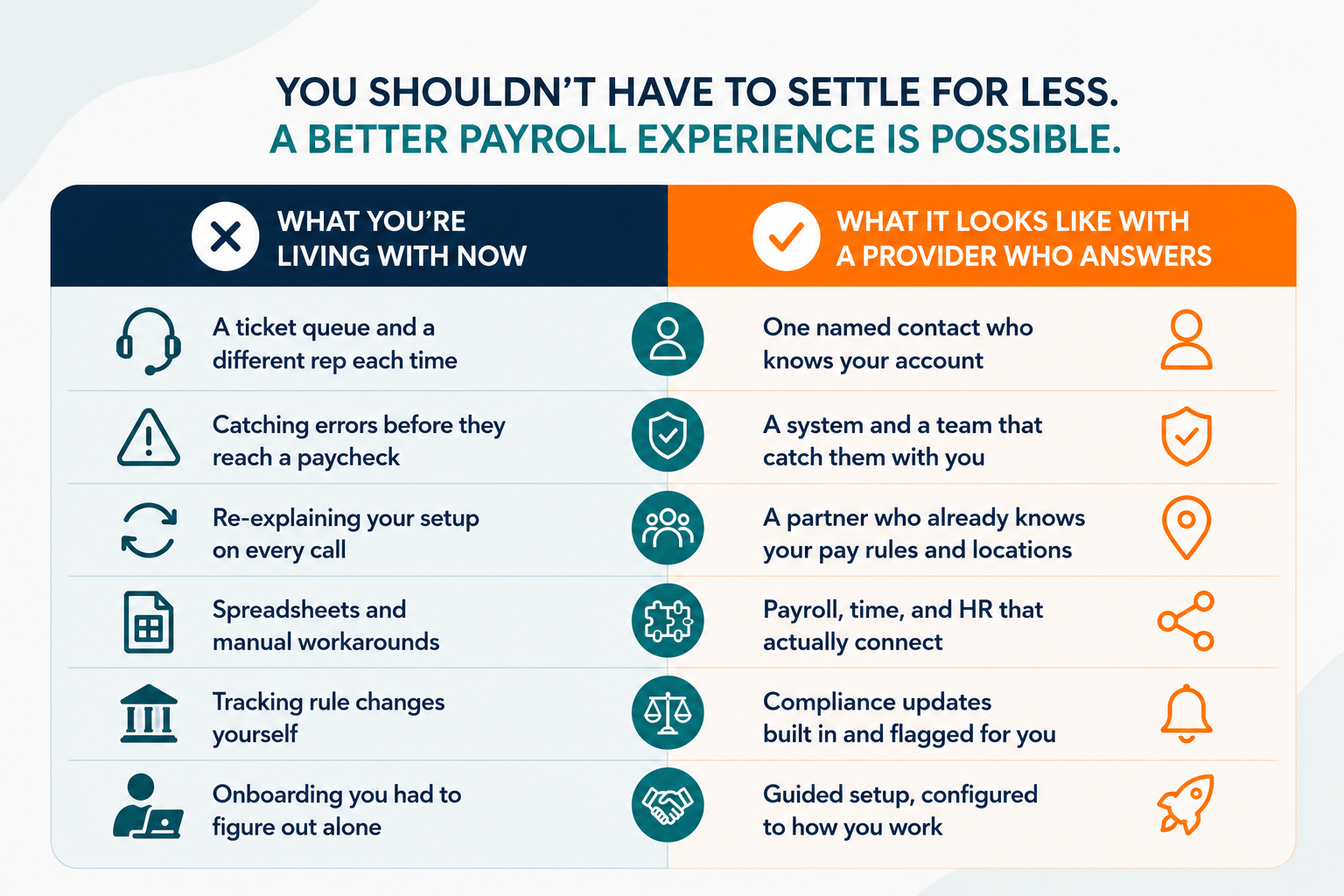
If a few of these signs are familiar, the next question is usually about timing and disruption, not whether to move. On timing, the cleanest moment to switch is the start of a quarter or the new year, when year-to-date totals carry over neatly, though a capable provider can move you mid-year and handle the historical data without a mess. On disruption, most of the dread people feel is a memory of a bad onboarding, not the switch itself. When the provider runs implementation for you, pulling your data, configuring your rules, and reviewing the first runs alongside you, the change is far smaller than the one you're imagining.
The honest test is this: how much of your payroll runs smoothly because the system is good, and how much runs smoothly because you personally hold it together? If it's mostly you, you've outgrown the provider, and there's a better setup waiting.
If this sounds like your Monday, it's worth a real conversation. At PayNW you get a named contact who knows your business and answers when you call, not a ticket number and a wait. Reach out and we'll walk through your current setup with you, no pressure and no script.

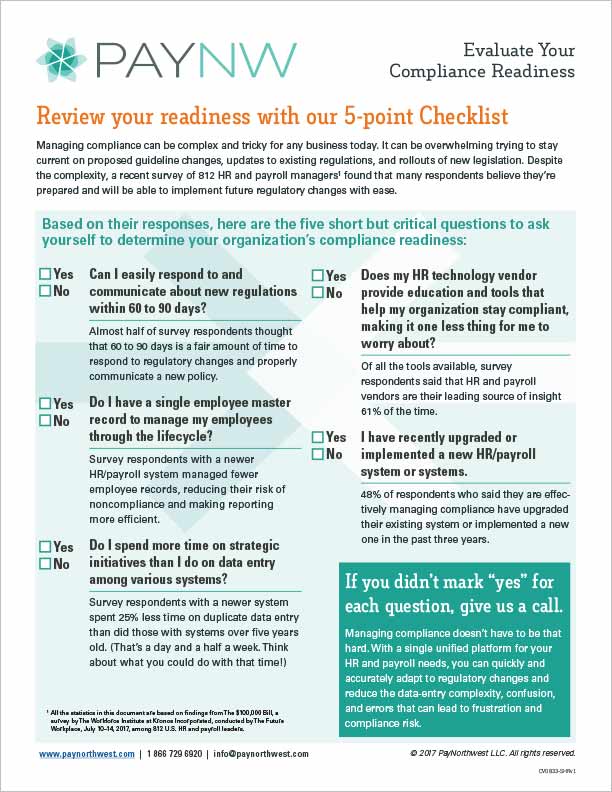
Are you prepared for the next wave of tax, healthcare and regulatory changes affecting payroll and HR? Managing compliance can be complex and tricky...
1 min read
To ensure the proper payroll and Human Resources (HR) system is in place for your organization, you first need to evaluate both your business needs...
-1.png)
This webinar has passed. You can check out our webinar library for any available recordings. Please join us for a free webinar! Correctly...