





Multi-State Employees: What Employers Need to Know Before Expanding Across State Lines
Learn the top payroll, HR, tax, and compliance considerations for multi-state employers, including remote employee impacts, labor law differences,...
7 min read
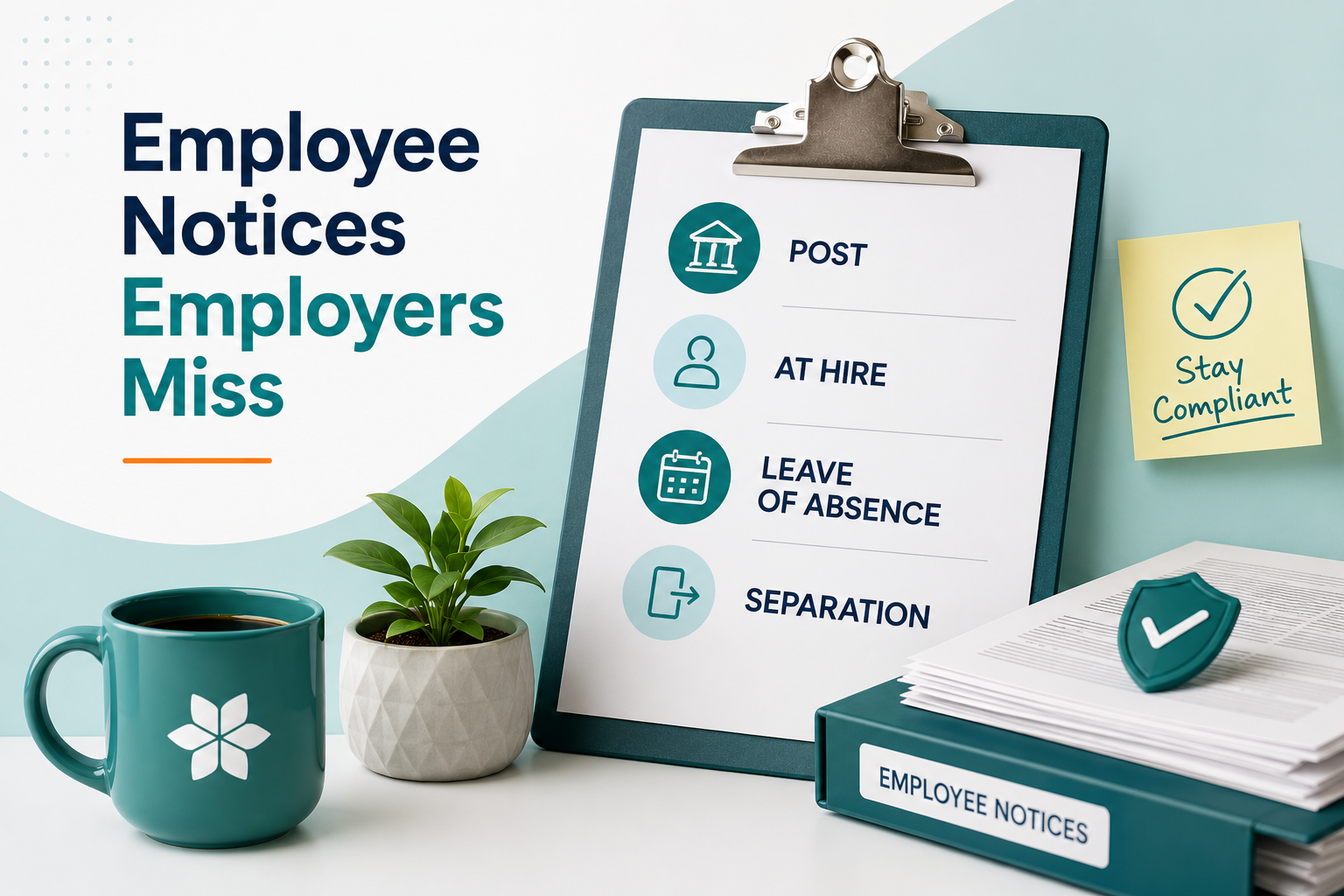
Most employers can point to the labor law poster on the breakroom wall. Far fewer can name every notice they are legally required to hand an employee at hire, when a leave starts, or on the day employment ends.
Notice obligations fall into four general buckets. Some must be posted continuously. Some are triggered by hiring. Some are triggered by a leave of absence. Some are triggered by separation. And a handful are tied to fixed calendar dates that nobody thinks about until they pass.
The complication is that federal law sets a floor, not a ceiling. Every state builds on top of it, and the rules follow where the employee works, not where the company is headquartered. An employer in Ohio with three remote employees in New York, Colorado, and California is subject to all four sets of requirements. That reality is what turns a manageable compliance task into a moving target.
Here is how the obligations break down.
Federal law requires most private employers to display a standard set of notices where employees can readily see them: the Fair Labor Standards Act minimum wage notice, the Equal Employment Opportunity notice, OSHA's "Job Safety and Health: It's the Law" notice, the Employee Polygraph Protection Act notice, the USERRA notice, and the FMLA notice for covered employers.
Every state adds its own. Most require postings on minimum wage, workers' compensation, unemployment insurance, discrimination, and safety. States with paid leave programs require program-specific notices on top of that. Cities add another layer, particularly where local minimum wage ordinances exist.
Two details cause most of the problems. First, posters expire. Many states reissue notices when the minimum wage changes, which happens in January in some states and July in others. A poster that was compliant in June may not be in August. Second, posting is not just a physical exercise. Remote employees have to receive the same notices, generally by email or through an intranet location they can reliably access, and employers should keep a record of that delivery.
New hires receive Form W-4 and Form I-9 as a matter of course. Beyond that:
This is where employers get caught most often, because the clocks are short, they are counted in business days, and they usually start running on the date the employer learns of the situation rather than the date the employee formally requests anything.
FMLA notices. Covered employers owe an eligibility notice and a rights and responsibilities notice, generally within five business days of learning that a leave may qualify. A designation notice follows, also generally within five business days of having enough information to determine whether the leave is FMLA-qualifying. If the employer intends to require a fitness-for-duty certification before return to work, that has to be stated in the designation notice. It cannot be added later.
State paid leave notices. More than a dozen states plus the District of Columbia now run paid family and medical leave programs, and Delaware, Minnesota, and Maine came online during 2026. Each has its own notice mechanics. Colorado requires employers to notify employees of the FAMLI program at hire and again after learning of a qualifying event. Washington requires written notice within five business days after an employee has been absent for seven consecutive days for a reason that could qualify. Oregon requires the model notice at hire and posted at every worksite. Employers operating in several of these states are managing several different triggers and several different clocks at once.
Benefits continuation during leave. Employees on extended leave need to know how their share of health premiums will be collected while they are not receiving a regular paycheck, and what happens if a payment is missed. This is not always a standalone statutory notice, but it is the single most common source of disputes when an employee returns and finds coverage lapsed or a large arrears balance.
State disability program notices. California, New York, New Jersey, Rhode Island, and Hawaii operate state disability insurance programs with their own employee notice and brochure requirements at the point of a qualifying absence.
COBRA triggered by reduced hours. A leave that reduces an employee's hours below the plan's eligibility threshold can be a COBRA qualifying event even though the person is still employed. Employers routinely miss this one because nobody was terminated.
Termination generates more required paperwork than any other event in the employment lifecycle, and almost none of it is federal.
COBRA. The employer must notify the plan administrator of a qualifying event within 30 days. The plan administrator then has 14 days to send the election notice. If the employer is its own plan administrator, the combined deadline is 44 days from the qualifying event. Missed notices carry an IRS excise tax of $100 per day per qualified beneficiary, capped at $200 per day per family, on top of potential private litigation. Two related notices are easy to overlook: a notice of unavailability when someone requests COBRA but is not eligible, due within the same 14-day window, and a notice of early termination when coverage ends ahead of the maximum period.
State separation notices. Roughly twenty states require a specific form or written documentation at separation, usually connected to unemployment insurance eligibility. The formats and deadlines are not consistent. New Jersey uses Form BC-10 at the time of separation regardless of whether the separation is permanent. New York uses Form IA 12.3. Nevada uses a DETR notice at the time of termination. Louisiana requires Form LWC-77, filed online and provided to the employee within 72 hours. Georgia requires a notice with dates of employment, wage information, and the reason for separation.
California as an illustration of the stacking problem. A single California termination can require a Notice to Employee as to Change in Relationship delivered immediately, the EDD's "For Your Benefit" pamphlet (DE 2320) no later than the effective date, a Health Insurance Premium Payment notice (DHCS 9061) for employers with 20 or more employees, Cal-COBRA notification, notice of continuation and conversion options under Labor Code 2808(b), and final wages due at the time of termination. That is five or six required items for one departure, and California is not unique in stacking them.
WARN. Federal WARN requires 60 days' notice for covered mass layoffs and plant closings. Several states have their own versions with longer notice periods, lower headcount thresholds, or both. New York and New Jersey both require 90 days. Employers planning a reduction should confirm state requirements before locking a date.
Retirement plan notices. Departing participants with a distributable balance receive a Section 402(f) rollover notice explaining the tax consequences of their options.
Final pay. Final paycheck timing is state law, and it varies from immediately on the last day to the next regular payday. Several states require accrued vacation to be paid out as wages. The pay statement itself is a required notice in most states and has to be accurate.
A short version of the recurring annual cycle:
Any employer can build a compliant notice process. The hard part is keeping it compliant. Minimum wages change and posters get reissued. New paid leave programs launch and bring new notice triggers with them. Furnishing rules shift, as they did for Form 1095-C. States add separation requirements. None of it arrives on a single predictable date, and none of it announces itself.
PayNW works with employers across the country, and keeping current with these changes is part of how we operate. We handle payroll execution, pay statement configuration, tax coding, and year-end wage reporting, and we track the requirements that touch those functions as they change in every state where you have employees. When a rule shifts, we want you to hear about it from us before it becomes a problem, not after.
Posting requirements, benefit plan notices, and leave administration decisions remain with the employer and, where applicable, the benefits broker, plan administrator, or counsel. Knowing where those lines fall is part of a clean compliance process too.
If you want to review how your payroll data, pay statements, and year-end forms line up with the notice rules in every state where you operate, let's talk.

Learn the top payroll, HR, tax, and compliance considerations for multi-state employers, including remote employee impacts, labor law differences,...
-1.png)
Employers with between 50-99 employees will get an extra year until they must offer health insurance to their full-time employees.

Due to the COVID-19 pandemic, employers and self-employed people had the opportunity to defer paying their share of their eligible Social Security...