
.png) Lori G. Brown
Lori G. Brown
There Is No CEO Playbook—But These 5 Things Came Close
.png?width=30&name=Leading%20with%20Lori%20Right%20Facing%20%20(Website).png) Lori G. Brown : November 12, 2025 at 8:00 AM
Lori G. Brown : November 12, 2025 at 8:00 AM
When I officially stepped into the CEO role at PayNW, I was stepping into some very big shoes.
Leadership does not come with a handbook.
Which is inconvenient.
Because there are definitely days when a handbook would be helpful.
There are days when the team needs clarity, the client is frustrated, the decision is overdue, the project has taken a mysterious left turn, and someone says, “Can I ask you a quick question?”
Every leader knows that question is rarely quick.
Over the last few years, I have written a lot about leadership.
Not because I think I have it all figured out.
That would be adorable.
I have written about leadership because it keeps showing up everywhere.
In CEO decisions.
In stay interviews.
In peer groups.
In interview questions.
In remote work.
In vendor relationships.
In parenting moments.
In after-prom neighbor notes.
In ADHD realizations.
In warning signs.
In softball games.
In moments where I got it right.
And in moments where I very much did not.
At some point, I started to notice something.
The lessons were not random.
They kept circling back to the same themes.
Not the generic leadership traits that show up on motivational posters.
The real ones.
The ones you actually see in a meeting.
The ones you notice when pressure hits.
The ones that show up when a leader is tired, challenged, uncertain, or standing in the middle of a situation that was absolutely not covered in orientation.
So I made a card.
Not a scorecard.
Not a personality test.
Not a “print this out and become a perfect leader by Friday” situation.
A reference card.
Because leadership is not about memorizing the right answers.
It is about knowing what to reach for when the moment gets complicated.
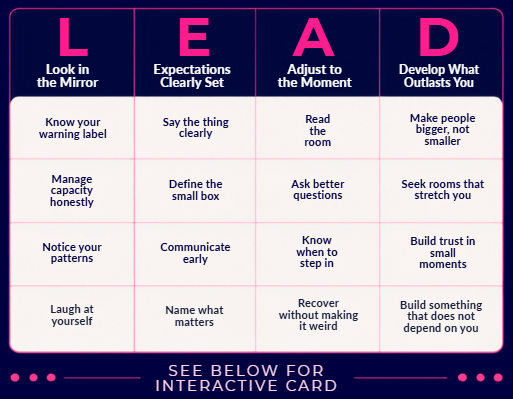
Around here, we are calling it the LEAD Card.
Each square on the card connects back to a story I have already written.
Some came from lessons at PayNW.
Some came from mistakes.
Some came from parenting.
Some came from ADHD.
Some came from rooms I had to grow into.
The card is the shortcut.
The blogs are the stories behind it.
So if one square makes you pause, that is probably the one to click on and read next.

The first section of the card starts with the leader.
Annoying, but true.
Before you can lead other people well, you have to understand what it is like to be led by you.
That includes your strengths.
It also includes your patterns, your pressure responses, your blind spots, and the things your team may have learned to work around without telling you.
Every leader has a warning label.
Some are just printed in larger font.
The “Look in the Mirror” section is about self-awareness. It is about knowing what you bring into the room before you start trying to lead everyone else in it.
That is why these squares matter:
Know your warning label.
What do people need to understand about how you lead under pressure?
Manage capacity honestly.
Just because you can carry something does not mean you should.
Notice your patterns.
The habits that help you may also confuse the people around you.
Laugh at yourself.
Leadership will humble you either way. A little humor makes the landing softer.
This section pulls from some of the most personal lessons I have written about, including my ADHD diagnosis, the strange systems that somehow work, and the warning label I would probably need printed in bold:
Confuses capability with capacity.
Which is rude.
And accurate.
The second section is about clarity.
And yes, the phrase sounds a little backward.
That is because we are making the E do some work.
But the idea is not backward at all.
Expectations should not be implied.
They should not be hinted at.
They should not be buried in someone’s head, waiting for a team member to guess correctly.
They should be clearly set.
This is where leaders either make things easier for their teams or accidentally turn everyone into amateur detectives.
I will take clarity over charisma every time.
Charisma may get people excited.
Clarity helps people move.
Expectations clearly set does not mean controlling every step.
It means giving people enough information to make good decisions without needing you to translate the entire situation from a conference room, airport gate, or random voice memo recorded between meetings.
Not that I know anyone who does that.
The “Expectations Clearly Set” section is about making the invisible visible.
That is why these squares matter:
Say the thing clearly.
Do not make people decode what matters.
Define the small box.
People deserve to know what they own, what matters most, and where the non-negotiables live.
Communicate early.
Communication works better before everyone is frustrated.
Name what matters.
If everything is the priority, nothing is.
This section connects directly to the leadership lessons behind clear expectations, vision, the small box, and proactive communication.
It also connects to one of my favorite parenting-meets-leadership moments: delivering notes to the neighbors before an after-prom party.
Because yes, apparently leadership can include teenagers in formalwear and a noise-management plan.
The lesson still holds.
Communicate before people start writing their own version of the story.
Their version usually has more villains.
The third section is about adaptability.
I have never loved the question, “What is your leadership style?”
It assumes leadership is one setting.
Like a toaster.
But leadership is more situational than that.
Sometimes your team needs coaching.
Sometimes they need direction.
Sometimes they need space.
Sometimes they need challenge.
Sometimes they need encouragement.
Sometimes they need you to stop talking about the destination and tell them where to park.
The “Adjust to the Moment” section is about paying attention before you respond.
That is why these squares matter:
Read the room.
Notice what is being said, what is not being said, and who is nodding while absolutely not bought in.
Ask better questions.
Curiosity is a strength, unless it starts to feel like a deposition.
Know when to step in.
Sometimes you coach. Sometimes you decide. Sometimes you get out of the way.
Recover without making it weird.
Mistakes are not the end of trust. Poor recovery might be.
This section pulls from the blogs about interview questions, working with different thinking styles, softball mistakes, and the many moments where leadership requires something other than your default setting.
Because default settings are convenient.
They are not always effective.
A good leader can read the room.
A better leader can adjust after reading it.
The last section is about impact.
Not performance.
Not optics.
Not how full your calendar looks.
Although based on that metric, some of us are apparently very important.
This section asks a harder question:
What remains when you are not in the room?
The best leaders do not just lead in a way that works while they are present.
They build people, trust, systems, and culture that continue without them.
That is harder.
It also might be the whole point.
The “Develop What Outlasts You” section is about leadership that leaves something stronger behind.
That is why these squares matter:
Make people bigger, not smaller.
People should leave your leadership clearer, braver, and more capable.
Seek rooms that stretch you.
Growth rarely happens when everyone around you already agrees with you.
Build trust in small moments.
Trust is usually built in the follow-up, the honest answer, the owned mistake, and the expectation set early.
Build something that does not depend on you.
If everything requires you, you have not built leadership. You have built a bottleneck with good intentions.
This section connects to peer groups, conference rooms, stay interviews, remote work, team trust, and the decision to build something stronger than one person’s ability to hold it all together.
That last part can be hard for high achievers.
Especially leaders who are used to being useful.
Especially leaders who have been rewarded for jumping in, figuring it out, and carrying the thing across the finish line.
But leadership is not proving you can carry everything.
Leadership is building something that does not require you to.
The LEAD Card is not meant to be cute.
Although, to be clear, I do appreciate a theme.
It is meant to be useful.
A way to look at leadership through four questions:
Am I willing to look in the mirror?
Are expectations clearly set?
Am I adjusting to the moment?
Am I developing something that outlasts me?
Those questions are simple.
They are not always easy.
Because leadership keeps changing the test.
A bigger team.
A harder decision.
A conflict you did not expect.
A season of pressure.
A person who needs something different from you than the last person did.
A moment where your old playbook does not work anymore.
That is the part of leadership I keep learning.
You do not become a leader once.
You keep becoming one.
Square by square.
Lesson by lesson.
Awkward question by awkward question.
Warning label by warning label.
And on the good days, maybe you look around and realize the people around you are clearer, stronger, braver, and more themselves because of how you led.
That is the card I want to keep coming back to.
Not because it has all the answers.
But because it reminds me what kind of leader I want to become.
And which square I probably need to work on next.
Gratefully,

Lori G. Brown : November 12, 2025 at 8:00 AM
When I officially stepped into the CEO role at PayNW, I was stepping into some very big shoes.

4 min read
Lori G. Brown : March 18, 2026 at 8:00 AM
Over the past couple of weeks, after I posted pictures from our leadership retreat in Hawaii, I have been asked the same question more than a few...

Lori G. Brown : May 20, 2026 at 8:00 AM
I am fairly certain my 12-year-old daughter, Sydney, made Little League history last week.She stole home.By walking.